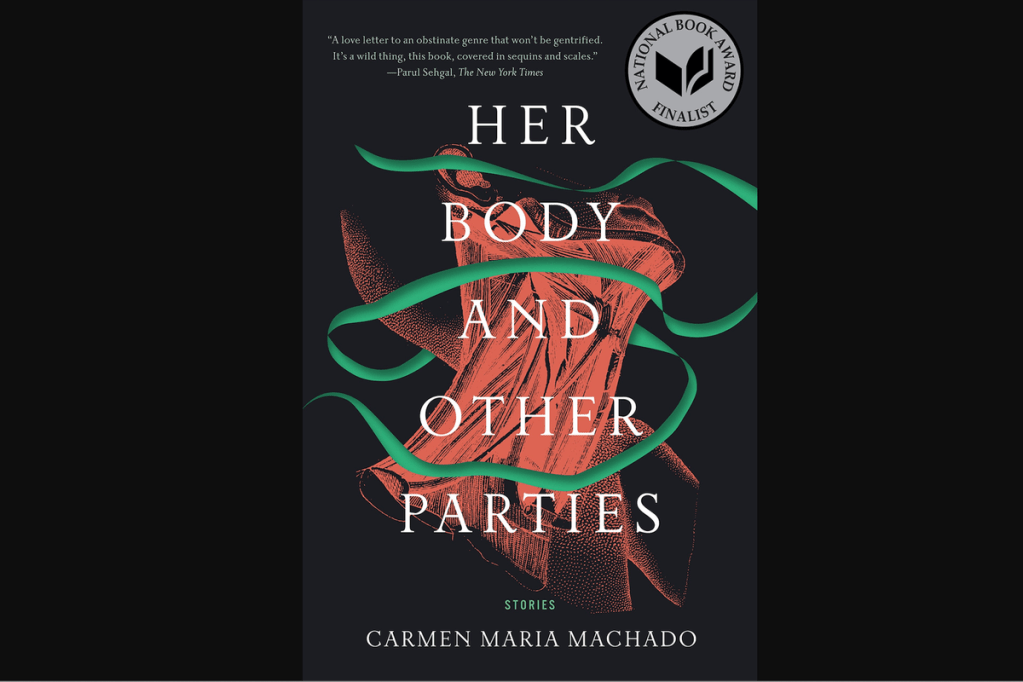
Next week, our class will start discussing Carmen Maria Machado’s short story collection, Her Body and Other Parties. This is a book that I’m deeply invested in, not only because of its beautiful writing but because it’s one I’m incorporating into my own work. I’ve been thinking with this book for some time, but returning to this book now has been particularly special. Since the outbreak of the pandemic, I’ve been thinking a lot about Machado’s short story, “Inventory,” in which a woman navigates her way through the U.S. to end-up on an island off the coast of Maine, alone. She is escaping a pandemic herself, one that, importantly, is transmitted through human contact. Meeting an ex-CDC employee, she is told that “the fucking thing is only passed through physical contact […] If people would just stay apart––” How apropos for 2020!
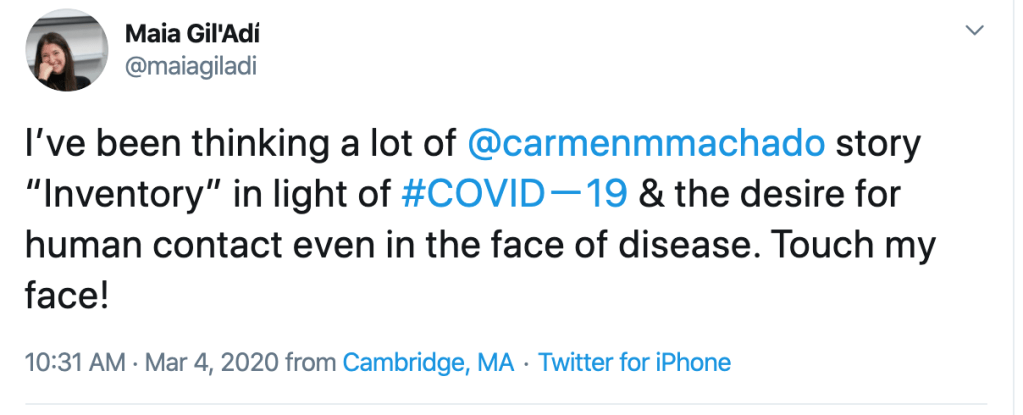
As I wrote in this tweet, and as the narrator of “Inventory” understands, the desire for human contact is so profound that it cannot be avoided. We put ourselves in danger, we betray ourselves (?) in order to feel another body close to ours. In the most difficult moments, touch, comfort, care is what we need most. But, what happens when, like our narrator, we are alone? This is the most horrific possibility the story itself presents.
I assigned this collection for our Latinx monsters class because of the innovative ways Machado implements the tropes of speculative fiction and horror in order to represent women, and in particular their bodies. Right before Boston implemented its “shelter in place” order, I also participated in a roundtable at NeMLA 2020 that centered on Machado and her work. The primary concern of the roundtable was examining her work as a turn in Latinx literary studies. Our roundtable considered the Latinxness of her text, where no overt markers of race or ethnicity are evident, and I’m interested in asking my students whether they considered Her Body and Other Parties a Latinx book and why.
As I stated in my NeMLA paper, Latinx scholars have demonstrated an affective attachment in reading Machado as a Latinx author, although her work evinces no overt signs of race and ethnicity (either Latinx or white). While she is technically a Latinx author, Her Body and Other Parties makes no reference to race or ethnicity. Resorting to lyrical “high art” literary language––MFA pedigree and training is evident here––the text allows all characters to “pass” (of course, this is a larger claim about our reading practices which see all characters not clearly identified racially or ethnically as “white”). Imaging Machado’s work as Latinx positions latinidad as a speculative endeavor that is outside the reach of language—unsayable and unknowable.
My paper focused on a comparative analysis of Machado alongside Han Kang’s novel, The Vegetarian. This examination of the speculative female body unearths unexpected yet interrelated narrative strategies, literary patterns, and networks; networks that are particularly significant in our contemporary moment in which difficult conversations of sexual abuse and its intersection with race, ethnicity, financial, and institutional power have dominated our zeitgeist.
The central questions that organize this work are: How do I consider my body? Where do I find its beauty? Where do I find its pleasure? How does the world demand I consider it and how do I make space for it within the world? I have been thinking a lot about a couple lines from a Muriel Rukeyser poem, “Käthe Kollowitz,”: “What would happen if one woman told the truth about/ her life?/ The world would split open.” Indeed, representations of the female body, sexuality, and desire in Machado and Kang rip apart not only the world, but the body, and the text itself. In centralizing the experiences and desires of women in their texts, Machado and Kang obliterate expectations of fiction—for linearity, wholeness, and resolution—while also inflicting pain on the self. The high literary style of both writers also associates this violence and self-abnegation to notions of aesthetic pleasure and artistic merit.
Machado’s short story collection is, as the title suggests, deeply concerned with female embodiment—its shape and size. It is also interested in food and eating, especially as it affects the female body. Kang’s novel, as its title suggests, is also concerned with eating, or, more precisely with its inverse, abstention—denial and rejection of the human body. Food, eating, the body: what should be sources of pleasure are instead ones of discomfort, pain, denial. Forbidding yourself of food so the scale reads 105 instead of 106, watching your hip bones jaggedly display themselves, a source of pride in their accomplishment. Delight in seeing how far you can push your body, delight in its pain. How far can I go? How small can I make myself? Seeing the least amount of space you can take—do I want to become invisible? How much pain can it endure? It, not I—a separation of body from self. How much pleasure can I achieve from its pain? Or, the pleasure in overindulgence, seeing how much you can take in, put away. How much can my flesh expand? How many layers can it take? How much space can my body demand?
In my work, I consider how both texts foreground the female body as a speculative arena through which self-abnegation and refusal are explored in relation to eating, hunger, and desire. The body acts as the space through which colonial and racial violences are explored and through which women enact their resistance and defiance against systemic patriarchal domination. However, resistance takes place not, as expected, through typical acts of dissent, but through forms of refusal and self-abnegation that hurts the self.
The women of Her Body and Other Parties enact a shadow feminism that manifests itself through forms of self-destruction, masochism, and a refusal of the typical bonds that would define us as women. In many ways, these women refuse to reproduce their relationship to patriarchal forms of power, yet in so doing hurt themselves, and at times, self-destruct. In a world that continually performs violence on the body of the female subject, why not refuse to eat meat and then food altogether? Why not become plant? Why not assume control over your own destruction? Why not become dress-ghost? Why not untie your ribbon and let your head drop to your husband’s feet? In Her Body and Other Parties we see a version of woman that is messy, porous, violent, self-loathing; one who refuses to remake and rebuild. The women of Machado’s narratives “seeks instead to be out of time altogether, a body suspended in time, place, and desire” (Halberstam 145).
Machado’s short story collection is concerned with many female-centered subjects: queer love, queer sex, sexual and gendered violence, the reimagination of fairy tales, motherhood and procreation. It is also deeply concerned with corporeality, female embodiment, eating, and fatness. Throughout eight short stories Machado lyrically tells various narratives that center women and their desires, the violence they endure and survive, and the systemic forms of cruelty and oppression women are always subject to—all in speculative and fantastical modes. The stories I will focus on here are also particularly interested in the female body, its weight, visibility, and undoing. “The Husband Stitch,” for example, reimagines the classic fairy tale, “The Green Ribbon,” which tells of a young girl with a green ribbon around her neck who refuses to tell her boyfriend-then-husband why she wears it. In their old-age, however, she allows her husband to untie the ribbon, causing her head to fall off. Machado’s reimagination centralizes male psycho-sexual desire and power over women and the passing-on of this power generationally. Ultimately, the text asks us to consider who has the power to undo and unbecome. The title of the story, it should be noted, is a reference to a purported surgical procedure in which one or more sutures than necessary are used to repair a woman’s perineum after it has been torn or cut during childbirth.
From the outset, the narrator of “The Husband Stitch” is interested in the choices she makes and the power to decide: “I have always wanted to choose my moment, and this is the moment I choose” (Machado 4)—selecting a young man at a party to at first have sex with, then date, and ultimately marry. The story, in this way, upends conventional notions of male-female power dynamics, opening with the narrator stating: “In the beginning, I know I want him before he does. This isn’t how things are done, but this is how I am going to do them” (3). “In the beginning” marks not only the beginning of the story, but the creation of the world, putting god-like power in the narrator’s hands. Her boyfriend-husband is incensed with her refusal to disclose the reason for her ribbon; unable to accept that a woman has information she makes inaccessible to him. Her husband’s curiosity and anger at her ribbon is mirrored in their son, who at first playfully touches her throat and then more hungrily demands for its discovery. Both man and boy are demanding of access to all forms of knowledge and enraged at the narrator’s prohibition to her secret. It is important to note that her secret is intimately linked to her body, its unity, and stability, which ultimately are undone.
In their old age, just as in the original fairy tale, the narrator resigns herself to her husband’s desires: “‘Then,’ I say, ‘do what you want’” (30). Untying her ribbon, the narrator’s “lopped head tips backward” and rolls off the bed, making her “feel as lonely as [she has] ever been” (31). The decision to unmake herself, literally unstitching her own head to appease her husband, is intimately linked to her affective position—she is separated not only from herself but husband, son, and community. We should ask ourselves were agency lies within the story and if the narrator’s permission is a consensual one or done from her own volition. I would like to propose that while the narrator is pushed by the male insistence and demands of her husband, it is crucial that the ribbon is only untied after she verbally allows him to do so; realizing there will never be a space or time in which she will not be demanded upon to account for her knowledge, the narrator chooses to undo herself.
Much as the ribbon causes confusion and anger because of the unanswerable questions it raises. Women’s bodies themselves become sources of mystery and fear in “Real Women Have Bodies.” Working at a dress shop, Glam, the story’s narrator discovers that she has been selling dresses inhabited by disembodied women, sewn into the material where they occupy the space in dress form: “She presses herself into it, and there is no resistance, only a sense of an ice cube melting in the summer air. The needle—trailed by thread of guileless gold—winks as Petra’s mother plunges it through the girl’s skin. The fabric takes the needle too” (134). The imagery of the needle and thread combines, as with “The Husband Stitch,” suggestions of bondage and domesticity, themselves associated with notions of sexuality and womanhood (of course, bondage can refer to a woman’s containment within social norms but also the sexual practice of bondage).
Yet it is the mystery of the women’s disappearance that lends the female body so much power in the narrative. Slowly fading away, the cause for the disappearance of hundreds of women is never explained, leading people to imbue them with unearthly power and danger: “It turns out that they think that the faded women are doing this sort of—I don’t know, I guess you’d call it terrorism? They’re getting themselves into electrical systems and fucking up servers and ATMs and voting machines. Protesting,” Petra explains to the narrator (144). Yet the fear that they instill come not from overtly aggressive or violent acts, but through silence and passivity, the unmaking of themselves as corporeal beings. The narrator describes the women in the dress-making room as “glowing faintly, like afterthoughts” (134) and their expression as indecipherable: “The faded woman won’t look away. She smiles. Or maybe she is grimacing” (145). She importantly also understands that all women are destined to disappear: “Soon, I’ll be nothing more, too. None of us will make it to the end” (147). The narrator implicates not only herself but all women in this disappearance, positioning the world as an inhabitable space for them as-is. However, as she has seen, women take on a new form of passive resistance which they refuse to escape.
I’d like to conclude by thinking of the story “Eight Bites,” in which a woman undergoes gastric band surgery in order to lose weight. Her sisters have undergone this surgery—implicating fatness as well as the desire for thinness and surgery as part of family tradition (kinship formations?). Unlike her sisters, however, the protagonist’s surgery does not have the same desired effects. In fact, the surgery not only causes a rift between her and her daughter, but unlike the “ghosts” that haunt her sister’s, the supernatural entity that haunts her house after the surgery is one that causes a form of externalized deep anger toward the self.
Not only does “Eight Bites” touch upon the toxic message women have internalized about body image, but also about the pleasures of self-harm and abnegation. The narrator’s self-inflicted violence finds its most poignant expression through the supernatural being that haunts her post-surgery: her fat-ghost; the fat she has attempted to get rid of but that now resides in her house. Before the surgery, the narrator desires the possibility to “relinquish control[,]” making everything “right again” (158); a desire to be unthinking and perhaps uncritical of her own body, much like the oyster she eats before surgery: “I was jealous of the oysters. They never had to think about themselves” (157). Much like Yeong-hye, the narrator of “Eight Bites” wishes for an undoing of the self, a state of mollusk-like (plant-like) mindlessness.
However, the fat-ghost disallows this and acts as a continual reminder of her decision inspired by self-hatred. Much like the oyster, her fat-ghost “is a body with nothing it needs” (165) and inspires deep, instinctual anger in the narrator: “I do not know that I am kicking her until I am kicking her. She has nothing and I feel nothing except she seems to solidify before my foot meets her, and so every kick is more satisfying than the last” (165). The act of kicking not only makes the ghost robust and entity-like, but also provides pleasure for our narrator. Here, she is exerting violence on an externalized formation of the self that she has originally rejected through the surgery but that has remained as a haunting presence. In fact, the story provides no possibility for comfort: realizing she was wrong in her decision, the narrator imagines the time of her death when she will ask forgiveness of the fat-ghost. Importantly, the haunting acts as an eternal manifestation of self-hatred created by the narrator herself: “She will outlive me by a hundred million years; more, even. She will outlive my daughter, and my daughter’s daughter, and the earth will teem with her and her kind, their inscrutable forms and unknowable destinies” (167). As with all the women of Her Body and Other Parties, female presence here enacts a form of mystery that can never be answered.
 Monsters, Hauntings, and Horror in Latinx Literature & Film