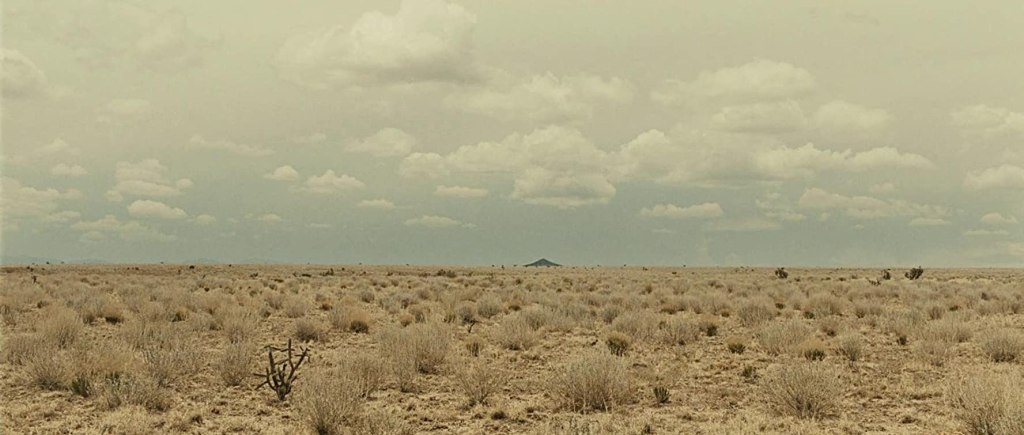
It’s strange to be reading and teaching a book like McCarthy’s No Country for Old Men in the time of the COVID-19 pandemic. Last week I wrote about the uncertainty and doubt that permeates the text, and particularly through Sheriff Bell’s discomfort at what seems to be a world quickly unraveling into chaos. Of course, Bell’s views are deeply entrenched in an antiquated notion of who belong to the nation; what the nation itself entails; changing demographics and societal norms he clearly has not adapted to nor understands.
The novel’s title is taken from William Yates’s poem, “Sailing to Byzantium,” and demonstrates the desire to escape a space that seems to be a world devoid of meaning and beauty––a chaotic, confusing, devolving world. My students incisively pointed out how the novel presents morality as an ambiguous force; something Bell does not want to understand. I found it interesting that on this reading, however, I was agreeing with Chigurh’s view of history, his implementation of justice. Much as the $2 million that instigates the novel’s plot––a narrative tool–-the coins Chigurh uses throughout to determine who lives or dies, act as tools of justice. Interestingly, while he uses these tools of chance (fate), his view of consequences and history are wholistic and staunchly predetermined. Before killing Carla Jean, Chigurh explains that while she was not directly involved in the stealing and hiding of the money, her choices and her husband’s have consequences:
Every moment in your life is a turning and every one a choosing. Somewhere you made a choice. All followed to this. The accounting is scrupulous. The shape is drawn. No line can be erased. I had no belief in your ability to move a coin to your bidding. How could you? A person’s path through the world seldom changes and even more seldom will change abruptly. And the shape of your path was visible from the beginning. (259)
Next week, our class will discuss the Coen Brother’s adaptation of McCarthy’s novel. I asked my students to consider the artistic choices this film makes, not only in terms of directorial ones, but acting ones as well. I’m particularly interested to hear how my students will react to those scenes that are omitted from the film, ones that I think are crucial for the text, in particular Llewelyn Moss’s conversation with the hitchhiker. Here, he presents a similar view of history and the consequences of choice that Chigurh does:
It’s not about knowing where you are. It’s about thinking you got there without taking anything with you. Your notions about startin over. Or anybody’s. You dont start over […] Ever step you take is forever. You can’t make it go away […] You think when you wake up in the mornin yesterday dont count. But yesterday is all that does count. What else is there? (227)
Like Chigurh, Moss understands the importance and severity of choice. Unlike Chigurh, Bell is determined in believing that he can implement change and be a force of good. As my students noted, perhaps Bell is beginning to comprehend this at the novel’s conclusion. Here, Bell reminisces not only about his patriotism, involvement in WWII, and his work in law enforcement, but also presents a larger network of violence that extends to his family’s colonial legacy through the Vietnam War. While he understands the importance of choice and action, until the end of the novel when he retires, Bell believes he can be a tool for good (much like the coin is a tool of death). Yet, as Chigurh poetically explains, one cannot put themselves outside of history: “I’m not sure why I did this but I think I wanted to see if I could extricate myself by an act of will. Because I believe that one can. That such a thing is possible. But it was a foolish thing to do. A vain thing to do. Do you understand?” (175). It seems that the only way that Bell can extricate himself is through making himself inconsequential.
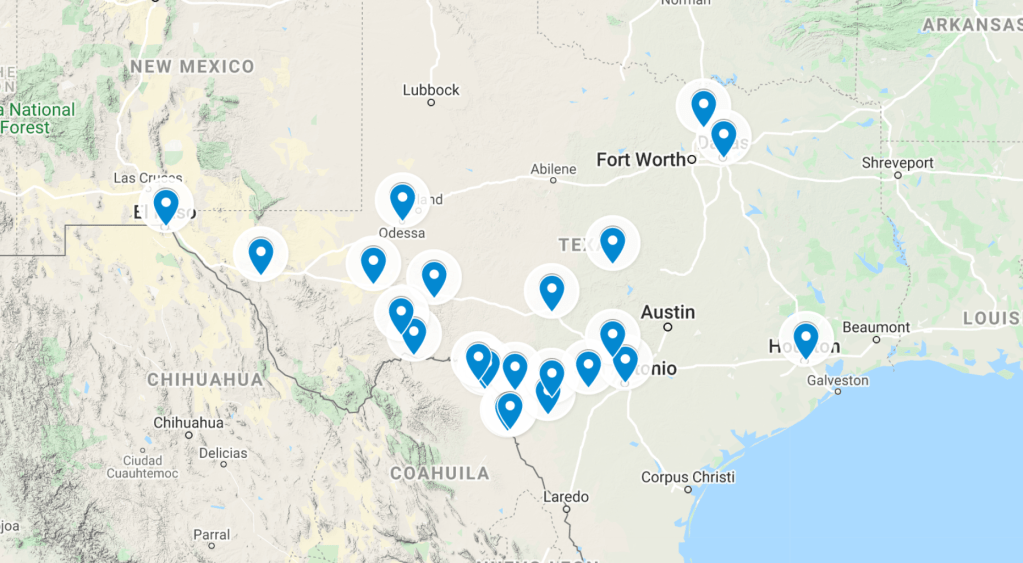
Finally, and on a totally different note, I was intrigued at the spaces this novel investigates. No Country is deeply rooted in Texas, spending most of its time in West Texas and those cities close to the border. I was interested in tracking the main character’s movement in the novel––in another iteration of this project, I would track each character individually and see in what places they intersect. Here is a map that details the places in Texas and Mexico Bell, Moss, Chigurh, and Carla Jean Moss go to throughout the novel.
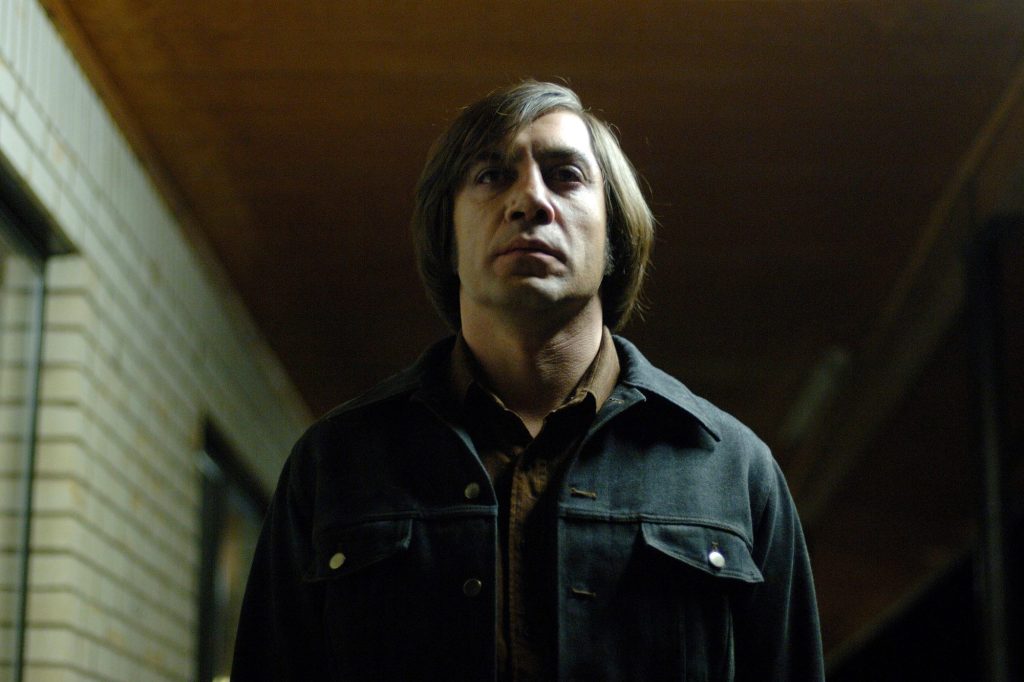
On a final final note: I can’t wait to hear what my students have to say about the choice of not only casting Javier Barden as Anton Chigurh, but also about his presentation. To me, there’s something fantastically queer about his presentation––the adoption of the pageboy haircut which feminizes him, while also making him that much more horrific, alien, Other.
 Monsters, Hauntings, and Horror in Latinx Literature & Film