This week “Monsters, Hauntings, and the Nation” will begin meeting online. I have been worrying about what these meetings will look and feel like, and having to come to terms that we cannot return to the ways before the pandemic (a strange phrase to write!). This group of students has been the best I’ve had in my time as a professor. This is not a nostalgic statement, but one I have been feeling all semester, and I’ll miss our in-person dynamic, rapport, and in-depth analysis of the text. I am hoping that at least this last thing we will be able to keep: a curiosity of the text and desire to investigate it with each other. If I know these students, I’m sure we will do our best under the circumstances.
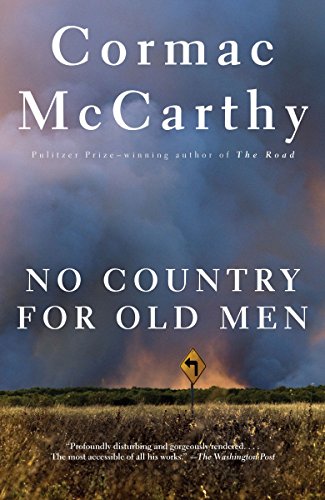
Perhaps it is because of the pandemic, but something has struck in re-reading Cormac McCarthy’s No Country for Old Men: uncertainty and doubt in the face of an unknown force and changing times. Since the pandemic started, things have felt particularly stressful and out-of-control, so maybe this is why I find myself feeling aligned with Sheriff Bell. To me this is shocking, of course, seeing as the text does a clear job of illustrating the xenophobia, conservatism, and racism of the sheriff and his representation of the borderlands and its people. It is unclear to me still if the text is writing against itself and revealing these racist tendencies, or attempting to write against them. Perhaps the text reveals the reader’s own views, ala All in the Family and the controversy over Archy Bunker’s character.
Even in writing this post, I’m struck by my own wishy-washy tone: too many “perhaps” and “maybes” here. Yet, if as I tell my students that a novel teaches you how to read it from its opening, uncertainty and fear is what structures No Country. The novel opens with Bell’s meditation on “what was coming down the pike” (4); a meditation riddled with “I don’t know what to make of that” and “I surely don’t” (3)––variations of this can be found throughout (62; 63; 71; 79; 95; 158). Through the remainder of the novel the sheriff continues to represent the border as suffering under a new form of violence; “somethin we really aint never seen before [sic]” (46). Of course, this new something is not only Anton Chigurh (the psychopathic killer in the novel) but also the wave of violence caused by the drug trade. This is problematically represented as being a Mexican occupation and Mexicans in the novel occupy a space of evil.
Not only is the sheriff burdened with the stress of the unknown, but Llewelyn Moss also is faced with terrifying unknowable forces. Finding the $2 million that instigates Chigurh’s hunt for him and his family, Moss “absolutely knew what was in the case and he was scared in a way that he didnt [sic] even understand” (17). This in part has to do with Chigurh himself, who is depicted as an unstoppable force of evil; perhaps something that has emerged from the U.S.-Mexico border itself––the force the sheriff has been fearing since the outset of the novel. This is also due to the landscape itself, which throughout No Country is represented as a space of darkness, violence, and doom.
My students have read the majority of the text for tomorrow (we’re concluding our discussion of the novel next week and discussing the Coen brother’s film adaptation the following). I’m most curious in our discussion tomorrow if they see Chigurh as a Mexican subject, as the film clearly portrays him to be (or at least “foreign” or “Latinx”). The only description of him comes late in the novel and is incredibly ambiguous: “The man turned his head and gazed at Moss. Blue eyes. Serene. Dark hair. Something about him faintly exotic. Beyond Moss’s experience” (112). Is Chigurh’s exoticism something that marks him as Latinx? Is his exoticism that reaches beyond Moss’s experience make him something not Latinx, since Moss is Texan and clearly has come into contact with many Latinx peoples?
Stay tuned for more as we discuss No Country and its film adaptation. I’m really looking forward to hearing what my students think tomorrow!
 Monsters, Hauntings, and Horror in Latinx Literature & Film